Showing posts with label Review. Show all posts

Wednesday, April 18, 2012

HBO's Girls is a victim of its own hype

Jemima Kirke, Lena Dunham and Allison Williams in Girls, the HBO series created by Dunham.

Given the hype that preceded Sunday's premiere of HBO's Girls, it was probably inevitable that the show itself was a bit of a let-down. After all, the series - which was created by Lena Dunham and counts Judd Apatow among its producers - was lauded by New York magazine, The New Yorker and The New York Times (I'm sensing a trend here) way back in March. The Daily Beast called it "the best new show of 2012," and Salon applauded the show's portrayal of female friendship. The acclaim was so immense that the inevitable backlash began a week and half before the pilot episode even aired. (And it just keeps going; as Alexandra Petri put it, "Now I think we're in the backlash to the backlash - or possible the backlash to the backlash to the backlash.")There was no way that any TV show was going to completely deliver on that kind of hype.

The fact is, everyone who tuned in to Girls on Sunday had probably already made up their mind about the series. Which, really, is quite unfair to Dunham, because it puts her show in the awkward position of being judged not on its own merit, but on its ability to perfectly, subtly, realistically portray an entire generation.

Girls doesn't manage to do that. Despite my status as a member of the series' target audience (young, urban, female, recent graduate of a liberal-arts college), I didn't feel that the series was an accurate reflection of me or my life. I certainly didn't identify particularly with any of the women at the center of the narrative; not with Hannah (Dunham), who throws a tantrum in a restaurant when her parents refuse to keep supporting her; not with Jessa (Jemima Kirke), a European free-spirit who romanticizes dying of tuberculosis in a garrett, like Flaubert, and whose sexual liberation has no place for birth control; not with the barely-glimpsed Shoshanna (Zosia Mamet), whose character is, at least in the pilot episode, reduced to a flurry of breathless femininity and a love of Sex and the City.

Tuesday, April 10, 2012

Review: Don't Trust the B---- in Apartment 23

Krysten Ritter and James Van Der Beek in ABC's Don't Trust the B---- in Apartment 23.

The unfortunately titled Don't Trust the B---- in Apartment 23, which takes over Happy Endings' time slot this Wednesday at 9:30, has some big shoes to fill. Happy Endings may have begun as a somewhat uneven Friends clone, but it grew into something wonderful, and the sitcom's second season was one of the most consistently funny series on TV this year.

Apartment 23's first two episodes, which are currently available on Hulu and ABC.com in advance of Wednesday's premiere, don't quite fill the hole that Happy Endings left in the schedule (and in my heart), but the show certainly has potential. The show may have a very slight premise - at this point, the plotting is very secondary to the jokes - but it has two fascinating characters at its core: titular bitch Chloe (Krysten Ritter) and a wonderfully smarmy, self-obsessed James Van Der Beek (played, in a spectacular piece of casting, by... James Van Der Beek.)

Sunday, March 11, 2012

Does Game Change humanize Sarah Palin?

Julianne Moore plays two sides of Sarah Palin in the HBO movie
Game Change.
Does Game Change humanize Sarah Palin?

That's the question I kept asking myself while watching HBO's original movie about the 2008 McCain/Palin campaign for the second time tonight. I went to an advanced screening on Tuesday night feeling that the movie didn't make Palin look bad, or at least worse than she made herself look. Some moments were too public not to be included, and many of them - the Katie Couric interview, the comment about Alaska's proximity to Russia on Charlie Rose - don't put Palin in the best light.

There were also moments, however, when Sarah Palin the hopeless naif and Sarah Palin the cunning politician took a backseat to Palin the person. Watching Julianne Moore, as Palin, comforting her sobbing daughter Bristol while the media tears the teen to shreds, or the tenseness that creeps into her face while talking to her son Track, fighting in Afghanistan, is to watch a devoted mother trying to grapple with her children's pain. It's heart wrenching. Similarly, watching the kindness with which Palin greets people with Down's Syndrome in rope lines is to understand just why people were so taken with her. It's these scenes that seem to justify the many critics who claimed that the film encourages the audience to empathize with her.

Monday, January 23, 2012

Dueling Marilyns vie for a part, and our hearts

Katharine McPhee stars in the new NBC series Smash.


There's a moment in the pilot of NBC's Smash, a TV series about the production of a Marilyn Monroe-based musical, that demonstrates the kind of sly wit that distinguishes Smash from that other musical TV series to which it will inevitably be compared.

The moment occurs after aspiring actress Karen Cartwright (American Idol alum Katharine McPhee) is summoned to director Derek Wills' (Jack Davenport) house one night during the audition process. Derek wants Karen to show him Marilyn's sexy side, and Karen, after storming into his bathroom and taking a moment of self-analysis, emerges wearing one of the director's dress shirts and crooning "Happy Birthday, Mr. President." She teases him, leans in to kiss him, and then rolls away and leaves the apartment.

This scene accomplishes two things. It proves to Derek that Karen shares with Marilyn a combination of innocence, sex, and marketing savvy that allowed the bombshell to, at least for a while, become a sex symbol without losing herself. It also shows the audience that Smash is both aware of the tropes that characterize musicals and willing to subvert them. Karen begins the hour as the innocent-but-talented small-town girl, reminiscent of 42nd Street's Peggy Sawyer. She ends it as a woman who can look at a situation and weigh what she is willing to do against what she wants. That, Ryan Murphy, is how you create both a compelling, fully realized character and a musical TV show.

And that is the last mention I will make of Glee, because Smash really couldn't be more different. The series centers around the production of Marilyn: The Musical, a show written by Tom Levitt and Julia Houston (Christian Borle, a Broadway actor best known for Monty Python's Spamalot, and Debra Messings), directed by Derek, and produced by Eileen Rand (Anjelica Houston). The second part of the pilot - and, based on the trailer, at least a few episodes more - documents the casting of Marilyn, which comes down to a rivalry between Karen and Ivy Lynn (Megan Hilty, best known for playing Glinda in Wicked).

The best thing about Smash is the feeling that the action is grounded in the reality of Broadway theater, a feeling that is likely influenced by the casting of Broadway vets Hilty and Borle. Forced references to the Spider-Man musical aside (we're living in a Book of Mormon world now, writers), the show gives off a sense of the real, decidedly un-glamorous life of hard work, unbearable pressure and constant rejection. The opening scene is a sadly funny example: Karen, lit up on a stage, performs a heartfelt rendition of Somewhere Over the Rainbow (a song, it should be noted, that brought McPhee much acclaim on Idol) when a cellphone starts ringing. Karen snaps out of her fantasy and is left standing in front of an audition panel, being shooed out as the director takes a phone call in the middle of her audition. (If, however, you want to see the real pain of an audition process in front of your eyes, watch the phenomenal 2008 documentary Every Little Step.)

It's not all dark, though. Smash also contains moments that validate all the pain and suffering and answer the question of why anyone would want to go through this. The ecstatic reception of a leaked Marilyn sing is one; the final scene of the episode, in which Karen and Ivy's auditions are intercut and the production team is captivated by their voices, is another. (That audition also acts nicely as a bookend to the opener, and clearly marks the show as Karen's story more than Ivy's.)

Which brings me to the songs. Smash, though it makes use of a few pop songs, largely relies on pieces that were written for the show, and they're generally good. The most attention will likely go to the closing ballad, "Let Me Be Your Star," but my favorite was the witty "The National Pastime," which featured Ivy, as Marilyn, purring out baseball-related double entendres while dancing with the New York Yankees.

I obviously enjoyed Smash - it's one of the best drama pilots I've seen in a long time. However, there are a few worrisome elements. Julia's ongoing personal story - she and her husband are trying to adopt a baby, but her work on Marilyn gets in the way - has the potential to be a powerful deconstruction of the effects that a career in theater can have on a marriage. It could also be a melodramatic series of the-show-or-me arguments that derails the drama happening onstage. Similarly, I fear that the rivalry between Karen and Ivy could quickly become a repetitive, sex-symbol vs. girl-next-door dichotomy (although, to both Hilty and McPhee's credit, they do a great job of creating well-rounded characters to counteract this sort of simple reduction). Tom's rivalry with Derek, on the other hand, is something I can't wait to see more of. Right now, Smash is much more Book of Mormon than Spider-Man. Let's hope it stays that way.

Smash premieres on Monday, February 6 on NBC, but is currently available in advance on Hulu and iTunes.

Thursday, October 20, 2011

The real threat on 'The Walking Dead' isn't the zombies; it's the women

Sarah Wayne Callies and Melissa Suzanne McBride in The Walking Dead. Photo courtesy of hollywood.com.

The tense, terrifying highway attack scene that opens "What Lies Ahead," the second-season premiere of The Walking Dead, was brilliant in the way that this show can be when everything goes right. The scene was excruciatingly long in the best possible way, ratcheting up the tension as the survivors crouched under abandoned cars on the freeway, staying silent and hoping against hope that the zombie horde shuffling past won't notice them. There is never a large-scale fight with the zombies in this scene, just unbearably increasing tension as IronE Singleton's (yes, that's how you spell it) T-Dog cuts his arm open, Laurie Holden's Andrea desperately tries to put her gun back together, and Norman Reedus' fantastic Daryl saves the day with his crossbow. It was a fantastic scene, and a great way to kick off the season. If only the rest of the episode had managed to keep it up.

I'm not going to go into the deadly dull scenes between Andrea and Dale or Shane and Lori - scenes that did nothing to move the story forward, and instead just rehashed the problems I didn't care about last season - the painful church interlude, or Rick's stilted opening monologue. Those aspects of the premiere have already been critiqued endlessly. Instead, I want to talk about one of the most worrisome aspects of the episode: the women of The Walking Dead.

Every problem in the episode was the result of female incompetence. The initial zombie stampede (that's not the right word... what's a really slow kind of stampede?) may not have been anyone's fault in particular, but it led to various situations in which the women were always to blame. Andrea's complete incompetence with a gun led to her near-death at the hands of a zombie; not only couldn't she reassemble her gun in order to shoot the thing, but her panicked squealing alerted the zombie that was already leaving to her presence, necessitating her rescue by Dale. Lori (Sarah Wayne Callies) spent the entire highway scene with her hand over Carol's mouth, because apparently the woman couldn't keep quiet on her own, even though the two young children in the group - not to mention the guy who sliced his arm open and was bleeding everywhere - had no problem shutting up. And then Lori's complete incompetence as a parent led to her son, Carl, getting shot while on a zombie hunt with Rick and Shane. (I'm barely forgiving Sophia for running from the zombies here because she is a child. Just barely.)

Even when the women weren't actively causing problems, they were conforming to every terrible stereotype imaginable. Andrea was being a pouty, spoiled princess who was angry because her gun was taken away after she proved herself completely incapable of using it; Carol dissolved into a pathetic mess as soon as anything bad happened; and Lori was, as usual, a shrieking harpy. The men, meanwhile, got to kill zombies, cut the zombies open, fix cars and generally be tough and manly. Look at the scene where our plucky band of survivors finds the church, and a few zombies within. Rick, Daryl and Shane burst in and take out the zombies with little-to-no fuss, while the women (and Carl, who is on a zombie-hunting expedition due to his mother's bizarre conception of what it means to be a good parent) huddle in the back, completely useless.

I do understand that Rick, Shane and Daryl are the only characters whose pre-apocalypse skill sets are applicable to their current situation. However, that hasn't stopped Glenn (Steven Yeun) or Dale (Jeffrey DeMunn) from picking up a few tricks. Andrea, Laurie and Carol all made it through the zombie apocalypse somehow - for a while, Laurie must have been on her own with her sister Amy - but apparently none of them learned anything during that time. It seems completely implausible that these three women made it this far, given their complete lack of skills that don't involve crying, whining and yelling. No wonder Sophia ran screaming away from that zombie; she must have just assumed it's the way her gender deals with these situations.

If The Walking Dead wants to become the show that the opening scene showed it could be, a few things need to happen. The story needs to stop grinding to a halt for boring conversations, Shane needs to either get a serious personality makeover or just die, and the writing needs to get better. The biggest problem, however, is that of the show's women. I know that the target demographic for a zombie show is largely male, but there are a whole group of women out here who love zombie movies, and who really want to like this show. We just need a female character we can relate to who isn't a complete basket case. I'm hoping that Lauren Cohan's upcoming appearance will help, but I'm a little afraid of what might happen. If the show's writers manage to turn Chuck's Vivian Volkoff and The Vampire Diaries' Rose into just another useless damsel-in-distress, I'm done.

Monday, September 26, 2011

What "Person of Interest" could learn from "Fringe"

James Caviezel and Michael Emerson in Person of Interest and Anna Torv, John Noble and Joshua Jackson in Fringe. Photos courtesy of forareasonblog.com and eonline.com.

The pilot for CBS's Jonathan Nolan-created, J.J. Abrams-produced Person of Interest turned out to be one of the better pilots of the fall season. The premise is intriguing, there are some badass action scenes, and Michael Emerson is... well, he's Michael Emerson. However, the premiere demonstrated a tendency to stick with a more procedural format and ignore some of the larger questions, which was also a concern when a little show called Fringe premiered three years ago. If Person of Interest  is to become a unique, intriguing sci-fi show rather than just CSI: 1984, it should follow the lead of Abrams' other sci-fi success. (Obviously I mean creative success, not ratings success. For the love of God, people, start watching Fringe so I don't have to spend the next year dying inside every time I see the Friday ratings.) Here are some pointers to help get the writers started.

1. Expand beyond the procedural
The first season of Fringe was largely a sci-fi procedural similar to The X-Files, in which the Fringe team solved mysterious cases while slowly uncovering the corners of the bigger picture. In the second and especially third seasons, however, the show expanded beyond the case-of-the-week structure, building two convincing worlds and revealing an epic, possibly apocalyptic conflict. The procedural element is still there, but these days it's always used in the service of the larger story and never, ever gets boring. Person of Interest might have a harder time following this lead, since it's on CBS, home of eight hundred iterations of CSI, but it's worth the extra work to find a compelling, long-term narrative to balance the procedural format.

2. Exploit the possibilities of your premise
One of the most fun elements of watching Fringe (besides playing Spot the Observer, which I'm terrible at) is seeing the way the writers have used the alternate universe as an opportunity to create a world with enough small differences from ours to seem alien, yet still recognizable. These differences can be used for dramatic effect, as was the case with the big reveal that the Twin Towers are still standing Over There, or they can be used in subtle ways that show how the two universes diverged, such as Red Lantern comics and the 11th season of The West Wing. Person of Interest has the potential to be a fascinating exploration of the role of surveillance in the modern world, and that premise could be used to do some really cool things. I'd like to see some time devoted to the dystopian possibilities of the surveillance web, or maybe some exploration into the ways that web can be used with social media. I just know Facebook is watching me...

3. Let your supporting cast shine
Right now, Person of Interest is keeping the focus squarely on Emerson's Finch and Caviezel's Reese at the expense of Taraji P. Henson's Carter. Fringe, on the other hand, has a rich cast of supporting characters, such as Astrid, Broyles and Nina Sharp, just to name a few. Fan favorite Lincoln Lee (Seth Gabel) just got promoted to series regular, and his stellar work in the fourth-season premiere totally justified that promotion. Let us get to know background players like Carter and Detective Fusco (Kevin Chapman); if they're half as interesting as Lincoln or Charlie (Kirk Acevedo) their increased screentime will pay off.

4. You can put your dour, humorless lead to good use
Much of the criticism leveled at Person of Interest had to do with Caviezel's lead performance. I didn't find him all that offensive - he was certainly great at all the ass-kicking he had to do - but his performance was largely limited to glowering, scowling and rasping his lines. (Seriously, someone has caught a case of the Christian Bale over here.) During the first season of Fringe, many similar complaints concerned Anna Torv's performance as Olivia, and they were pretty much on target. The show worked around that, however, presenting Olivia as an emotionally stunted, closed-off character who gradually warms up to Peter and Walter, and eventually giving her a kick-ass, wisecracking doppelganger with a better haircut and much more personality. The doppelganger thing obviously won't work with Person of Interest - unless there's an alternate universe we don't know about - but the point is remains that Anna Torv went from being one of the worst actresses on television to one of the best. Show 'em what you can do, Caviezel.

5. Include a cow
Why? Because cows make everything better. And they provide milk.

Friday, September 16, 2011

Review: "Up All Night"

Christina Applegate and Will Arnett in Up All Night. Photo courtesy of tv.com.


Up All Night was, as you may recall, one of the new shows that I was most excited to watch this fall. It has a killer cast - Christina Applegate, Will Arnett and Maya Rudolph - and, based on the early trailer released during the upfronts, it managed to be funny while also being honest about the struggles of being a new parent. Having now seen the first episode, which aired Wednesday night on NBC, I still see a lot of potential in the show. There are, however, a few kinks that need to be worked out.

Let's start with the good. Applegate and Arnett give excellent, likable, grounded performances as Reagan and Chris, new parents who are struggling to balance jobs with their new baby while denying that they can't party like they used to. Arnett in particular gives a charming performance that, unlike so many of his great past roles (GOB Bluth and Devon Banks, to be precise), eschews over-the-top caricature in favor of a realistic portrait of a new stay-at-home father coming to grips with his obligations.

This isn't to say that the show is unfunny. It's definitely funny, although I found few laugh-out-loud moments and more sly, chuckle-inducing humor (this could be due to the fact that many of the pilot's best jokes were in the trailer that I had already seen). One of the funniest moments came when Chris, on a desperate search to find normal cheese, as opposed to "that fancy cheese over by the salad bar," happens upon an old lady who wants to tell him how cute his baby is. Twice. The fact that this innocent woman has "come after" baby Amy more than once sends Chris into a hilarious and believable spiral of paranoia about his child's well-being. Maybe it's just the fact that I grew up with an overprotective mother (hi Mom!), but this scene rang particularly true to me.

Some of the best scenes of the pilot, however, weren't really about baby Amy at all. They were about the  struggles that Chris and Reagan face as later-in-life parents, both of whom have successful careers, who are suddenly forced to face the fact that their entire life is about to change. To me, the character's ages really puts a fresh spin on what could be a fairly standard series about coping with a new baby. Chris and Reagan are very modern parents; they've been married for seven years in the pilot episode, they both already have fulfilling lives, and they still love to party. Their decision (or not - the first scene of the pilot shows Reagan taking a pregnancy test, but we don't really get a sense of whether the baby was planned) to have a baby at this time in their lives is an increasingly common one in a world where many people spend years getting advanced degrees and finding success in their careers before deciding to have children.

To me, Chris and Reagan are symbolic of the sort of delayed adulthood that is common these days (and I'm not criticizing - my fiance and I are both eagerly putting off full adulthood by getting advanced degrees - a trait that sets them apart from the previous generation of television parents. Their delayed adulthood also explains a scene that, I suspect, might strike some in the audience as an example of very bad parenting. On their anniversary, Chris and Reagan end up going out late, getting drunk and singing karaoke, only to wake up the next morning with hangovers and a crying baby in the next room. This is the sort of behavior that, in the different context, would come off as negligent; here, however, it serves as an example of the kind of sacrifices that new parents have to make in order to raise a child. The inane fight that Reagan and Chris have in the same scene is similarly realistic, and allows the show to express, through Chris, the anxiety that someone with a career can have when they leave to take care of a child.

This kind of fine-grained realism, however, is shattered in any scenes that involve Maya Rudolph's Ava. Part of the problem seems to be that Rudolph's character was originally conceived as a publicist rather than a Tyra-esque talk show host, and the quick retooling of the pilot allowed for cracks in the scenes involving Ava's talk show. The bigger problem, however, is that Rudolph's scenes play like they're from a completely different show - their aesthetic is the cartoonish surreality of 30 Rock rather than the realism of the other two-thirds of the episode. The thing is, Rudolph is a wonderful naturalistic actress - see Away We Go if you don't believe me - who has clearly been directed here to behave like one of her SNL characters rather than a real human being. Ava's cartoonish, party-all-the-time vibe makes her a counterpoint to Chris and Reagan's new life, but her diva antics also make it difficult to understand why Reagan is such a close friend of hers. I would like to see the writers humanize Ava by delving into her friendship with Reagan and allowing Rudolph to take her performance down a notch.

Up All Night has the makings of an excellent, realistic-yet-comic look at a subset of parents that hasn't been thoroughly explored in popular culture: older, married couples who are firmly established in their "adult" lives without really being adults, and who find that parenthood completely changes their lives by, in some way, forcing them to finally grow up. The show needs to retool the talk-show portions of the story, and add its very realistic perspective to that underdeveloped story thread. The tension between parents and their childless friends is a very interesting one to explore, and if Up All Night can convincingly portray that tension, it could become a great show instead of a merely interesting one: a Modern Family for the almost-adult set.

Friday, July 8, 2011

Review: "True Blood" Season 4

A very shirtless Eric Northman (Alexander Skarsgard) in "You Smell Like Dinner," the second episode of True Blood's fourth season. Photo courtesy of nydailynews.com.

I've been entirely too spoiled by The Vampire Diaries' breakneck pacing, consistent characters and snappy writing to think of True Blood as anything but an inferior knockoff (despite the fact that the HBO series premiered before TVD). I'm still watching the fourth season, largely because it is summer and there is nothing else on, but I'm treating it as a soapy, sexy diversion rather than an actual TV show with believable characters, coherent storylines, or dramatic stakes. This is not only making it much easier to watch - it also keeps me from spiraling into depression when I remember that, a mere three weeks ago, this time slot was occupied by the far superior Game of Thrones.

Since I no longer have any emotional investment in any of the characters, I will evaluate the storylines based on their potential for interesting character development (not much) and hot guys getting naked (lots and lots). As such, the opening scene of the season premiere - in which Sookie made it to Fairyland, only to discover that it was actually an illusion that covered up a nasty, goblin-ridden desert in which you could be trapped by eating glowing fruit - did almost nothing for me. It's been quite a while since I cared even a little bit about Sookie's problems, and this bizarre moment did not make me care about them more. Even the death of her grandfather, Earl Stackhouse, from light fruit-related causes was underwhelming, largely because it is now a given that, if Sookie cares about someone, a shitstorm of trouble is about to come their way. The extremely obvious Persephone overtones that went with the scene did not make it any better.

One storyline, however, that does have potential is Bill's ascension to the title of Vampire King of Louisiana. I've never hated Bill as much as some people do, but I did find his constant moping over Sookie, not to mention his complete lack of understanding of just why she might not trust him, extremely irritating. However, based on the first two episodes King Bill is a vast improvement; not only does he have a much better house, he's powerful, sleeping with various hot ladies, and can order Eric around. I'm hoping that he has actually moved on from Sookie, and that we're not going to find out that he's really just hiding from his love for her or some other buzzkill like that.

Now that Bill has seemingly moved on, Sookie is finally free to get together with Eric. Now, I knew that Eric's (SPOILER ALERT) memory loss was coming, but I'm still not happy about it. I liked the idea of Sookie playing games with Eric, who now owns her house and wants to own her as well. I love Eric just the way he is, in all his deadly, sarcastic glory; I don't need another, lamer version of Eric, no matter how much time he might spend with his shirt off. I want Sookie to learn to love the real Eric, flaws and all, and while Pam and Bill dealing with this new turn of events might be fun for an episode or two, I have no doubt that the writers will drag it out until no one can stand it any longer.

Regular readers of this blog will no doubt remember that my absolute least favorite element of the show is the continued victimization of Tara. Those people might think that I would be pleased about Tara's transformation into a badass cage fighter in a (seemingly) healthy relationship with lovely girl named Naomi. I'm glad to see that Tara is, at least for a couple episodes, free of the constant terrible experiences that plagued her life in Bon Temps (although that will probably last for all of ten seconds), but I'm a bit uneasy about her newfound lesbian relationship. This show has a tendency to divide its women into damsels-in-distress, who are generally straight, and tough women who can take care of themselves, who are generally lesbians and often vampires. Tara's turn to lesbianism reinforces the show's underlying truth, that women who are attracted to men are also dependent on men. Tara could easily have been in a healthy relationship with a man, but on this show healthy relationships between a man and a woman are an impossibility.

There are lots of other plots going on, and based on previous evidence none of them will come together in a coherent fashion. That means that, as much as I want to care about Lafayette joining a coven, Jason being turned into a werepanther, and Jessica and Hoyt's marital problems, but I know that none of these subplots will have any bearing on the season's main arc, so I don't. (And as far as Sam's relationship with Navajo shapeshifter/skinwalker Luna, I don't even want to care about that.) I'm really just in this for the naked Eric and the possibilities that arise with Bill as King of Louisiana; anything else along the way is just a bump in the road.

Monday, June 6, 2011

"Doctor Who:" Series Six So Far

Karen Gillan, Arthur Darvill and Alex Kingston in "A Good Man Goes To War." Photo courtesy of topuspost.com.

The first half of Doctor Who's sixth series came to an end with "A Good Man Goes To War" on Saturday. (Warning: This episode has not yet aired in the U.S. If you haven't seen "A Good Man Goes To War," stop reading now, because there are major SPOILERS ahead.) Since the show won't be back until the fall, I thought now would be a good time to discuss what has happened so far, and to predict what might come to pass when the show returns.

I'll get to the serious OMG-moments later in this post, but I first want to note that this is one of the most consistent runs of Doctor Who I have ever seen. This show can be remarkably inconsistent - for every "Human Nature" and "The Family of Blood" or "The Girl in the Fireplace," there is a "Daleks in Manhattan" or "Fear Her" - but the first seven episodes of the sixth series have all been remarkable in their consistency. The weakest episode was probably "The Curse of the Black Spot," but even the pirate-centric episode was entertaining (unlike "Fear Her"), and the pirates even made a return appearance in "A Good Man Goes To War."

While there were no truly bad episodes in the first half of the season, these episodes also featured one of the my new favorite episodes of the series as a whole. "The Doctor's Wife" ranks with the aforementioned "Human Nature" and "The Family of Blood" and "The Girl in the Fireplace," as well as the other excellent episodes "Blink" and "Vincent and the Doctor," as one of the top episodes of the rebooted series' run. Even if the other episodes had been terrible, I would have loved the season purely for the inclusion of "The Doctor's Wife;" as it was, it has been a great seven episodes, with that most excellent episode as a true standout in a series of solidly good-to-great hours.

Another excellent feature of these seven episodes has been the way that the season's major storyline has been prominently featured. Often in Doctor Who, the big story has been teased only intermittently throughout the season, and then come to play an important role in the final two or three episodes. (This is especially the case in Series Three, with the appearance of the Master, and Series Four, where the excellent Doctor-Donna revelation was barely brought up in the season's earlier episodes.) It's only Episode Seven, and many hints - the appearance of the Flesh and the creepy woman with the eye patch as two examples - have already been integrated into the major story.

It was clear as early as the first trailer for the season that Alex Kingston's River Song would play an important role in the season, and the seventh episode brought her character into the story in a big way. (Seriously, if you haven't seen "A Good Man Goes To War," stop reading NOW.) I still don't know how I feel about River Song being Amy and Rory's daughter, Melody Pond, largely because it makes her (apparently romantic) relationship with the Doctor seem a little creepy. However, I can't deny that the revelation seriously complicates the storyline as we know it so far. I'm a little worried, though, that this twist will take away from the suspense of the series. After all, we now know that little Melody will be safe, and will ultimately be protected by the Doctor, which makes the quest for her recovery less of an issue. Since it appears that finding Melody will make up the bulk of the second half of the season - which it might not, because what do I know? - it lessens the dramatic tension quite a bit to know that she will ultimately be alright.

I said before that the knowledge of River's true identity makes her relationship with the Doctor... strange, to say the least. However, there is dramatic potential here. Throughout the rebooted series, we've seen the Doctor's (mostly female) companions develop a romantic attachment to him, an idea that has been explored even more potently with Karen Gillan's Amy, who met the Doctor as a child and became extremely attached. Now, Amy has moved on and is happy with Rory, but another example was forthcoming in "A Good Man Goes To War:" Lorna Bucket, the young Cleric who joined the military purely to find the Doctor, having met him once as a child. Her story is similar to that of the individuals in the Series Two episode "Love and Monsters" - the people who aren't privileged enough to become companions, those who are touched by the Doctor and then spend their lives trying to regain the magic. The notion of the way the Doctor draws people to him, sometimes to an unhealthy extent, is one that is ripe with potential. This is the facet of the Doctor's relationship with River that could blossom into something really interesting.

There are a lot of interesting plot threads leading into the second half of the season. The use of the Flesh, for one, holds a lot of promise, as its existence has already proved critical for several plot devices. I'm also looking forward to the reemergence of the angry Doctor, the terrifying man whose name, in the language of Lorna's people, has come to mean "great warrior," the man who can summon an army at the mere mention of his name. The tension between who the Doctor is and what he has done has always been an excellent source of dramatic tension for the series, the knowledge that the man who never carries a weapon was responsible for the destruction of two species and countless other deaths. Davros used this contradiction to mock the Doctor in "Journey's End," and it was flung in his face again by Madame Kovarian in "A Good Man Goes To War." Watching the Doctor reconcile the two halves of himself - the one that strives for peace, and the one born in blood - has made for some compelling television in the past. I have no doubt that the second half of this season will be even more compelling, and that River Song and Melody Pond will play an important role in allowing the Doctor to embrace the mess of contradictions that makes up his self.

Sunday, May 15, 2011

"Castle:" Why You Should Be Watching

Nathan Fillion and Molly C. Quinn in Castle

Now, usually when I tell people to watch a show it's because it's a cult favorite that pushes boundaries and is in imminent danger of cancellation. Anyone who read my column in the Swarthmore Phoenix will remember the way I shamelessly begged people to watch Fringe for weeks and weeks (and weeks). In my defense, Fringe was renewed for a fourth season, yet another piece of evidence that executives and showrunners at FOX read my musings on a regular basis. (If you need more proof, this was published on February 3, one month and eight days before FOX aired the Glee episode "Sexy," which addressed the many, many problems I had with Brittany and Santana's relationship. Some might say this was a coincidence, but I suspect that the more accurate explanation is that Ryan Murphy reads my writing."

However, today I'm here to suggest you watch ABC's Castle, which is in no danger of getting canceled, having been renewed waaaay back in January, and which is far from a cult show, despite the fact that star Nathan Fillion played Mal Reynolds in Firefly, a cult show if there ever was one. And since Castle is fairly popular and no danger, I'm not going to beg; instead, I'm simply going to suggest that you devote an hour of your time on Mondays to watching this fun, witty police procedural.

I know that "fun" and "witty" are words that don't often appear in the same clause as "police procedural," unless they happen to be separated by a string of negative polarity items. (For a definition of negative polarity items, look here.) However, Castle takes what is often a dour, humorless drama - as the sexual assault of the week on Law & Order: SVU demonstrates as well as anything - and makes it into a show so lighthearted, so full of witty one-liners and sharp comedy, that you almost forget there are murders taking place every week.

A large part of the humor on Castle comes from its irascible leading man, best-selling author Richard Castle, brought to life by Fillion. Anyone who has seen Fillion in anything - Firefly, Doctor Horrible's Singalong Blog, or Two Guys, A Girl, and a Pizza Place - knows that the man had an undeniable, rouge-ish charm about him, one that permits him to say truly disgusting things and still come across as cute. (Example: his immortal line from Doctor Horrible, also know as the best line in the history of anything, which can be found here. I'm not going to repeat it, because this is a family site, and by family site I mean that my parents read it.) Fillion's natural charm makes the shallow, cocky Castle seem lovable rather than awful, and makes his readings of lines such as "I really am ruggedly handsome, aren't I?" come across as cute while also being impossibly vain.

At first glance, it might seem that it is only Fillion's charm and admittedly rugged good looks (despite the weight he has gained since his Firefly days) that keep the show from running into the ground. After all, it is a fairly formulaic procedural based on a laughable premise. In short, Castle is called by the NYPD when a murder is committed that resembles a crime in one of his books, and stays to shadow Detective Beckett (Stana Katic) because he is friends with the mayor. Apparently his friendship with the mayor extends so far that he is allowed in interrogations, on stakeouts, even in raids. Sometimes he even fires a gun, not that he's had any sort of police training or anything. Because that would be totally cool with the trained law enforcement officials he endangers with his lack of skill on a regular basis. But back to the show...

The reason that the premise occasionally seems to make sense is Castle's chemistry with his costars, in particular with Beckett. I'm getting a little tired of the will-they-or-won't-they plot that's been dragging on for two seasons now, but such is the curse of detective procedurals; you have great chemistry between your two leads, but if they actually get together the momentum of the whole thing just collapses. Just ask Moonlighting. Or don't, because it got canceled a mere one season after the two leads hooked up. However, despite the laggardly pace of the Castle-Beckett romance (or lack thereof), it can't be denied that the leads have excellent chemistry, and their scenes are always entertaining.

The show's best scenes, however, are those that involve Castle and his teenage daughter, Alexis (Molly C. Quinn). They may not have the most realistic parent-child relationship on TV - either that, or there's a lot of yelling and door-slamming that happens off screen - but their storylines distill the nice moments from the stew of angst that is being a teenager in a lovely, funny and often touching way. I would take their relationship over Beckett and Castle's any day, and not just because scenes that involve Castle and Alexis also tend to involve Susan Sullivan as Castle's mother Martha, and she's just great. She's like a nicer, more supportive Lucille Bluth, and while I love me some Lucille, after watching so much Arrested Development and Archer, it's nice to see a parent occasionally support their child.

Castle is far from groundbreaking television, but it's a sharp, quick-witted take on the usually bogged-down procedural genre, with a charming male lead who is matched by the supporting cast. In addition to Beckett, Alexis and Martha, Seamus Dever and Jon Huertas are great as the interracial cop duo Ryan and Esposito. They always seem to have popped in from their own buddy cop movie - one of the good ones, not Cop Out or Rush Hour 3. Some people like the episodes where Castle goes darker, like this season's two-parter in which Castle and Beckett foil a terrorist attack in New York that had undertones of 9/11, but for me the best episodes are the one in which the quips are constant and the good time are rollin'. Sometimes the bullets fly too, but that's all part of the fun.

Monday, April 25, 2011

"Archer:" The Best Show You're Not Watching

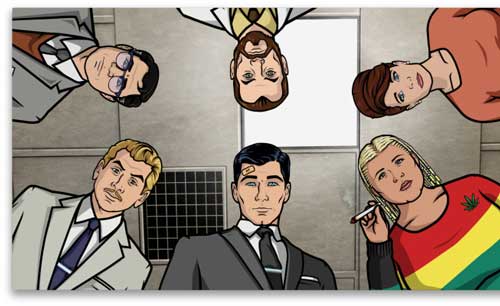
Clockwise from top left: Chris Parnell as Cyril Figgis, Lucky Yates as Dr. Krieger, Judy Greer as Carol/Cheryl, Amber Nash as Pam, H. Jon Benjamin as Sterling Archer and Adam Reed as Ray Gillette
I suppose I should qualify the statement "the best show you're not watching." You could, after all, already be watching FX's absurd spy comedy Archer, in which case you are already awesome. You could also be ignoring other wonderful shows, like Fringe or Community or The Vampire Diaries, in which case Archer would merely be one of the best three or four shows you're not watching. However, if you, like me, already watch the aforementioned shows, but have missed out on Archer because it's on FX, or you don't like animation, or you simply haven't heard of it, then you should listen up, because Archer is actually the best show that you aren't watching.

Created by Matt Thompson and Adam Reed (the guys behind such previous cult shows as Frisky Dingo and Sealab 2021), and featuring the best voice cast on television, Archer is a workplace/family comedy in the vein of Arrested Development. The show takes place at a spy agency, ISIS, run by the cold, snobby Malory Archer (the fabulous Jessica Walter, also known as Lucille Bluth) and revolves around the exploits of Malory's son Sterling (H. Jon Benjamin), the organization's top spy. The time period is some ambiguous and possibly nonexistent era when the Soviet Union and the KGB still exist, but the characters talk on cell phones and are perfectly capable of using Skype.

Benjamin's Sterling Archer is one of the most famous secret agents in the world, which is rather surprising given that he is completely incompetent at his job. He regularly blows his cover in order to pick up women, often abandons his missions because he sees something better going on, and is constantly fighting with fellow agents Ray Gillette (Adam Reed) and Lana Kane (Aisha Taylor), his seductive ex-girlfriend, not to mention his mother. Archer is basically Arrested Development's G.O.B., but with even more of a god complex and access to a lot of guns. He's a somewhat endearing (depending on the day) man-child who drinks, smokes, and screws his way through life. And like G.O.B. he even has an illegitimate son, although this one is a wee baby named Seamus rather than dumb jock Steve Holt.

The rest of the cast is fabulous too; Walter nails it as Malory (although granted, she's basically playing the same character she did on Arrested Development) a greedy, distant boss whose love of expensive things is only overshadowed by her love of men. One of series' best ongoing jokes is her relationship with Nikolai Jackov (Peter Newman), head of the KGB and possible father to Sterling. Aisha Taylor imbues Lana with seduction and danger, while at the same time making her unable to resist engaging with Sterling whenever she disagrees with him (which is all the time). Their combative, flirtatious (at least on Archer's part) relationship is one of the most amusing parts of the show.

The supporting cast also provides a lot of laughs, particularly Judy Greer's dimwitted, extremely slutty receptionist Carol (or Cheryl; it's unclear) and Chris Parnell's nerdy yet sex-addicted accountant Cyril. Much of the supporting players' job is to provide an even more insane backdrop against which Sterling, Lana and Malory can seem at least a little more human, but the subplots involving the office workers are often just as funny as the main storylines, and are generally even more absurd.

One of the nice things about Archer being an animated show is the freedom the writers have to create elaborate action sequences on the shoestring budget. There are just as many explosions and gunfights as you would expect from a typical action movie, although they tend to have an absurdist edge to them. One nice running gag is when Archer, as generally unrealistic as it is, calls out action movies for showing their heroes walking away from explosions or giant gun battles with their hearing completely intact, and a recent episode set in Russia mocked the action trope in which a character is the target of massive machine-gun fire and somehow never gets hit. The way that Archer makes fun of action movies is one of the most consistently amusing elements of the series.

I should also mention that Archer has amazing opening credits (sorry this isn't the real credits, which are very hard to find, but the remake is really quite close to the original, so shout-out to SkipShot77):


Take my word on this: Archer is a slick, giddily fun, edgy spy comedy that will have you laughing out loud even as you cringe at the characters' behavior. And it's extremely easy to catch up on: only twenty-two episodes at twenty minutes each makes this a perfect distraction during final's week or over the summer. Watch it now, and thank me later.

Wednesday, April 20, 2011

"Game of Thrones" Controversy: Is Fantasy Just for Boys?

Mark Addy, Lena Headey and Jack Gleeson in HBO's Game of Thrones
Anyone who has watched television or been on the internet in the past few months has probably heard about HBO's luxurious and expensive adaptation of Game of Thrones, the first novel in George R.R. Martin's ongoing fantasy series A Song of Ice and Fire. Those who follow television news and gossip a little more carefully have probably heard about the controversy surrounding Ginia Bellafante's review of the series for the New York Times, specifically the way in which the author implies that fantasy series are "boy fiction," not for women, claiming that the many, many (many) sex scenes that appear in the first few episodes were placed there as "a little something for the ladies," and because "no woman alive would want to watch otherwise." Bellafante goes on to say that she has "never met a single woman who has stood up in indignation at her book club and refused to read the latest from Lorrie Moore unless everyone agreed to The Hobbit first," a statement which is not only completely irrelevant to the task at hand, which is reviewing a TV show and not pontificating on perceived gender differences, but which also demonstrates that she has an extremely limited group of female friends. I for one have never heard of Lorrie Moore, but I am a voracious lover of Tolkien who has, on several occasions, dressed up in a homemade elf costume just because I could.

Bellafante has also clearly never made the acquaintance of Ilana Teitelbaum, who wrote a brilliantly insightful article in the Huffington Post about the sexism inherent in Bellafante's article, namely the idea that women aren't bothered with watching fantasy, and would instead spend their time shoe shopping and watching Sex and the City. Indeed, in the opening paragraph of Bellafante's article (I'm going to stop calling it a review, because there is very little actual reviewing happening here), she says that the show's opening credits should come with a warning stating, "If you can't count cards, please return to reruns of Sex and the City." For the record, while I am a huge fantasy nerd, I also really enjoy stereotypical female activities like shoe shopping, spa days and lunches that include mimosas. The two are not mutually exclusive.

I'm not even going to go into all the sexism (aimed, oddly enough, at her own gender) contained in Bellafante's article, partly because Teitelbaum does the job much better than I ever could, and partly because I think it's fairly apparent in the aforementioned quotes. (Seriously though, just because someone happens not to like Game of Thrones doesn't automatically imply that they're a woman, and even if they are a woman, it doesn't automatically imply that they will be watching Sex and the City. They could be watching baseball, or Fringe, or Community.) Instead, I want to respond with my own opinions about Game of Thrones, the first episode of which I decided to watch before writing this post.

I should state that, because I am not a critic for any of your fancy newspapers, I did not get screener copies of the first six episodes of the season, so this review is based entirely on the pilot episode. Having noted that, I really liked the show. Scratch that: I LOVED it. Game of Thrones was well-written and well-acted, the production values were absolutely top-notch, and there was just enough sex and violence to provide a nice, gritty atmosphere without completely upstaging the plot, although the producers could have cut down a bit on the exposed breasts. Plus, there were zombies. Zombies! I particularly enjoyed the performances of Sean Bean as Lord Eddard Stark, a man torn between loyalty to his king and his family; Peter Dinklage as Tyrion Lannister, the dwarf brother of Lena Headey's Queen Cersei who is witty, often drunk, fond of prostitutes, and much tougher than he looks; and the luminous, marvelous newcomer Emilia Clarke as Daenerys Targaryen, descendent of the deposed king who is now being used a bartering tool by her nasty brother to get his kingdom back. Clarke perfectly captures Daenerys' innocence and fear, and her performance in the scene of her wedding to savage warlord Khal Drogo (Jason Momoa) is mesmerizing.

Speaking of Daenerys and her forced marriage to Khal Drogo, the scene later in the episode in which she unwillingly consummates her marriage is a refutation of Bellafante's assertion that the sex was put into the series for the purpose of pandering to women. Even if all the sex in the episode was not in the books, which is most certainly was, there a three major sex scenes in the episode, and none are the sort that strike me, a woman, as being particularly sexy. They are: a scene in which Tyrion pays four prostitutes to have sex with him at once; Daenerys' consummation of her marriage, which is, to put it bluntly, rape; and a scene in which Queen Cersei is glimpsed having rather vigorous sex with her twin brother (not the dwarf, her other brother). These scenes are not titillating so much as degrading, and the first two in particular serve as a commentary on the place of the women in the fictional kingdom of Westeros and, by extension, the very real setting of medieval Europe.

There are certain small problems that I had with the series. The number of characters and their shifting allegiances confused me, and I don't know if I would have been able to follow had it not been for the assistance of my boyfriend, who has read A Song of Ice and Fire. The episode was also extremely expository, and while the exposition was well done, there's only so many times you can hear a character refer to another character as "my brother" or "my husband" without completely giving up on the verisimilitude of the thing. However, these were small quibbles, and I suspect that the second in particular will be resolved in a few episodes, after the audience has become better acquainted with the intrigue. I, for one, will definitely be watching the second episode come Sunday, and I can't wait to see where the series takes me. I might be a little late though; I have to get in some shoe shopping first.