Friday, October 14, 2011

"Community" knocks it out of the park in every timeline

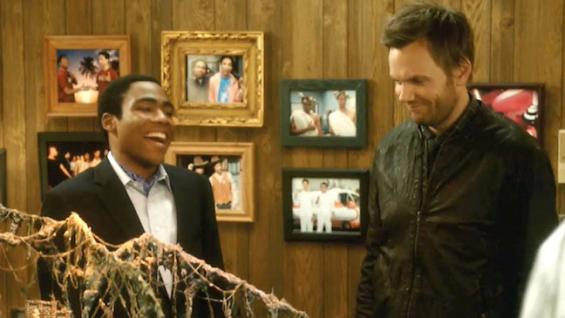
Photo courtesy of hollywoodreporter.com.

I've been in something of a minority concerning Community the past few weeks. A lot of viewers and critics have been complaining about a drop in quality on the basis of the last three episodes, but I thought that "Biology 101" and "Competitive Ecology" in particular were great, and I found "Geography of Global Conflict" quite likable despite its flaws. Tonight's "Remedial Chaos Theory," however, blew those three episodes out of the water. The multiple-timeline adventure was equal parts hilarious, moving and deeply twisted; everything that Community does well, packed into a fast-paced high-concept twenty-minutes.

There was a lot going on here, but the biggest theme of the episode was the way in which the characters' relationships are inextricably (yet unevenly) intertwined. Every person in the group has a unique dynamic with every other person, and we got to see many permutations of those dynamics. So, in order to break down the episode into more manageable pieces, I'm going to focus on some of the relationships we got to see play out over the course of seven different timelines.

Troy and Britta. This relationship is actually one of my favorites on the show, but it hasn't gotten a lot of screentime: they bonded in "Interpretive Dance" and had a falling-out in "Competitive Wine Tasting," and that's about it. There have been a number of moments, however, that have indicated that Troy is attracted to Britta - one of the best came during "Mixology Certification," when Troy found out that Jeff and Britta had been making out in the backseat of the car - and the lovely moment they shared tonight, eating candy cigarettes and gently connecting, was a reminder of Troy's crush. Britta reminding Troy that he doesn't have to be like Jeff in order to be a man was also great, a nice indication that, of the two men, Troy is really the responsible one.

Jeff and Annie. These two are going to hook up this season, right? No matter how you feel about that (particularly given the character's respective ages), there's no denying that Joel McHale and Alison Brie have some serious chemistry. I know the fire in the darkest timeline was started by Britta's joint, but it could just as easily have been ignited by their smoldering gazes. Of course, the whole thing is problematized by Jeff's protective feelings towards Annie, and her admission that he reminds her of her father (and will likely grow even more complicated when Annie moves in with Troy and Abed). Jeff never had to protect Britta the way he does Annie, so their relationship has a completely different vibe to it. A completely different, incredibly sexy vibe.

Troy and Pierce. This relationship is fairly underdeveloped, but there were some nice scenes here. Given Pierce's character arc from last season, it's immediately understandable that he would be upset by Troy's decision to move in with Abed, and of course he would try to get back at Troy by giving him the troll doll that haunted his nightmares. It's equally clear that Troy, who is good-hearted and mature, would really be grateful to Pierce for taking him in, and the scene where he says as much is beautifully understated. Well, until Pierce tries to take the box back and all hell breaks loose.

Shirley and everyone. Shirley is one character who has never had a particularly close relationship with anyone else in the group. Abed has Troy, Jeff has Britta and Annie, and even Pierce is fairly close, at various times, to various other group members. Part of this is because, as she says in the episode, she has a life outside of Greendale, which is something that sets her apart from the others. However, it's become clear both this week and last week that she really wants to connect with these people, and she does it by mothering them. To have Jeff shut down her baking is really to have Jeff tell her that they don't need her; it's no wonder she breaks down in two different timelines.

Jeff and everyone. There's no getting around it; this episode made it fairly clear that the group is happier and healthier without Jeff around. He manipulates everyone else into getting the pizza so he won't have to get up, with disastrous results every time. The one time that everything turns out fine is the time he leaves, so he isn't there to reject Shirley, belittle Troy or take advantage of Annie. Hell, the reason everyone manages to have a great time at the end is because Britta is allowed to start singing "Roxanne," something Jeff kept putting a stop to. By the end of the episode, Jeff is on the outside looking in. That moment may be the beginning of the serious, self-reflective Jeff storyline that Dan Harmon has been teasing for this season.

Those descriptions made the episode sound unbearably melancholy, which it was in some ways. However, it was also totally hilarious, so here are some of the best jokes.
  • Pierce's constant repetition of his anecdote about having sex with Eartha Kitt in an airplane bathroom - not to mention his many explanations for how the story was relevant to the conversation - was amazing. I kind of want to know the whole story now... (except I really don't.)
  • The really dark timeline, and the scene at the end that followed up on it, was amazingly funny in the most twisted way possible. It reminded me a lot of Archer, with the same kind of it's-so-tragic-it's-funny-again vibe.
  • Abed didn't have a huge amount to do this episode, but his smile as he greeted Britta and Annie at the door was great, as was Evil Abed's solution to the dark timeline problem. When has growing a goatee ever failed to solve something?
  • Jeff hitting his head on the fan was funny no matter how many times it happened. Joel McHale is a giant.
  • The "Roxanne" dance was a moment of pure, exuberant joy. It's the sort of thing I always want to happen at my parties, but it never does.
  • "There's no such thing as Single-Malt Platinum Boobs and Billiards Club?"

Monday, October 10, 2011

Why "The Big Bang Theory" distrusts parents

Christine Baranski as Beverly Hofstadter and Johnny Galecki as Leonard in The Big Bang Theory. Photo courtesy of hollywood.com

The first four episodes of The Big Bang Theory's fifth season have exemplified the show's recent unevenness. "The Skank Reflex Analysis" was solid, "The Pulled Groin Extrapolation" was wildly entertaining, and "The Infestation Hypothesis" and "The Wiggly Finger Catalyst" were mediocre at best. However, these four episodes shared one common attribute: each explored the twisted, traumatic relationships the major characters have with their parents, making The Big Bang Theory a show about the many, many ways that our parents screw us up. I haven't seen this many dysfunctional parent/child relationships on a TV show since Lost.


The trope of overbearing parents and the children who rebel against them is hardly a new phenomenon, and sitcoms in particular have been mining those relationships for comedy for decades. The real difference between other shows that explore these relationships - like Everybody Loves Raymond and Seinfeld - and The Big Bang Theory is that the former always assumed a relationship that, at bottom, wasn't so bad. Ray Barone's parents may have driven both he and his wife absolutely crazy, but there was no doubt that everything they did came out of love for their son. Seinfeld showed a dysfunctional relationship between George Costanza and his parents, but it was balanced out by the fairly normal (by sitcom standards) Seinfeld family.

The Big Bang Theory, however, has never shied away from linking the characters' present-day difficulties to their twisted relationships with their parents. The first four seasons showed us that Leonard's desperate need for affection - a need that manifests itself in his constant desire to be part of a couple - is the direct result of a mother who was so cold and detached that the boy had to build a robot in order to ger a hug. Sheldon, on the other hand, rejected the affection of a mother who didn't understand him along with her evangelical beliefs. Penny clearly has a problematic history with her father, as she remains convinced that he wanted her to be a boy, and it has been heavily implied that her string of hookups and failed relationships is an attempt to validate herself to a replacement father-figure. And in case that last one wasn't Freudian enough for you, Howard has a stereotypical, unseen Jewish mother on whom he is completely dependent, and who he is currently trying to replace with Bernadette.

The current season, however, has taken the parent-bashing to new heights. The last four episodes have nodded at the strained relationships that six of the seven major characters have with their parents. (As of yet, Bernadette's family has been unexplored, as her character exists mostly as a way for Howard to explore his own maternal issues.) In these episodes, we've found out the following facts about the character's relationships with their parents:

  • Penny doesn't just have issues with her father. Her facial expression when Sheldon fires off a comment about her mother's weight after she takes the last pot sticker tells you all you need to know.
  • Dr. Beverly Hofstadter has not softened. Her instruction to Leonard to buy one of her parenting books from Amazon if he needs more relationship advice is cold, to put it mildly.
  • Howard, in attempting to marry the opposite of his mother, is now preparing to marry his mother. Also, his dependence goes further than we thought, since he can't even cut his own food.
  • Raj's parents will take away his money if he dates a non-Indian girl. (Odd that they don't care about Priya and Leonard, but that's inconsistent writing for you.) I feel like fear of parental disapproval has to be at the bottom of his inability to talk to women.
  • Amy is trapped in a state of perpetual adolescence by her repressive upbringing, in much the same way Sheldon and Wolowitz are. Her friendship with Penny is an attempt to escape from the mother who signed her yearbook, "Self respect and a hymen are better than friends and fun."
  • We don't get into specifics about Sheldon's upbringing here, but the man spends an entire episode playing with trains and another episode being unable to understand that "It's not what it looks like" isn't some kind of riddle, but rather Penny's attempt to cover up her one-night stand with Raj.
When you look at that list, you get a picture of a group of emotionally stunted people, trapped at different points in their development by terrible parenting choices. Raj is still in a "girls have cooties" phase, Howard can't wean himself from his mother (figuratively... we hope), Sheldon has no understanding of adult sexual relationships, Penny acts out in order to get attention, Amy just wants to be one of the popular girls, and Leonard enters relationships in a desperate quest for affection. This is some seriously dark stuff. Honestly, if it weren't for the laugh track, there would be moments here that would rival the darkest moments in Community episodes like "Mixology Certification," "Abed's Uncontrollable Christmas," and "Advanced Dungeons and Dragons." These characters have moments that make George and Lucille Bluth look like good parents and Lindsay, Buster and G.O.B. look like well-adjusted people.

I'm not saying that I have a problem with this, or at least with the specific material presented here. And I'm not saying that family dysfunction and bad parenting can't be funny, because I love Arrested Development and Archer. I'm just a little queasy about the uniformly bad portrayals of parents that Chuck Lorre is giving us here. There is not a single parental figure on the show who appears to have effectively raised a child: the most normal person here is probably Leonard, and he was raised by Beverly Hofstadter (who, for the record, is one of my favorite characters on the show). If you can get past the easy jokes that these relationships provide, and get right down to the show's core, it's about a group of broken people trying to work out their parental issues with each other, a fact that might make The Big Bang Theory, of all things, one of the most depressing shows on network TV. Who would have ever expected that?

Friday, October 7, 2011

'Community' has become even MORE awesome than before

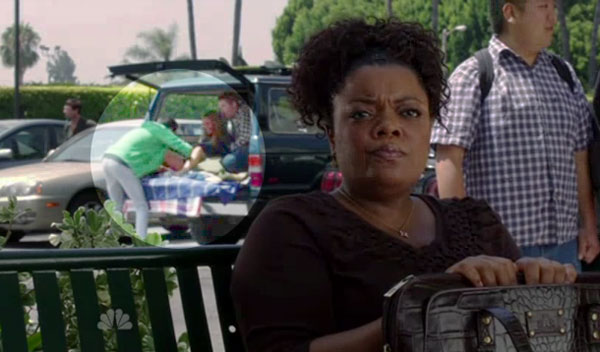
A scene from Community's "The Psychology of Letting Go." Abed can be seen in the background delivering a baby. Photo courtesy of warmingglow.uproxx.com.

I might be a little late to this particular Community party, but this is pretty amazing. The second-season episode "The Psychology of Letting Go" - the episode about the death of Pierce's mother or, to some people, the one where Britta and Annie start oil wrestling - features a story about Abed meeting a pregnant classmate, helping her reconcile with her boyfriend, and ultimately delivering her baby. Don't remember any of that? Neither did I, until I re-watched the episode and focused entirely on the background, where Abed's story plays out. Keep a close eye on this video to get the whole story:


Yes! Fantastic! This is why I love densely layered shows like Community and Arrested Development; because no matter how many times you watch an episode, you can still pick on awesome new things, even entirely new plots that run through a whole episode. It's like playing "spot the observer" during Fringe!

"Simpsons" cancellation: who's getting screwed here?

Photo courtesy of guardian.co.uk.

It's becoming increasingly likely that the upcoming 23rd season of The Simpsons will be its last. The increasingly contentious negotiations between Fox and the show's cast and production team must be settled by today if the show is to continue past the upcoming season, and there is no evidence that the two parties are any close to striking a deal.

According to as Facebook statement by Harry Shearer (Mr. Burns, among others), the producers have agreed to a 45 percent pay cut in order to lower the series' budget. The actors, who were originally asked to agree to the same pay cut, countered with an offer to cut their salaries by 30 percent, which was rejected by the network. In his statement (via New York Magazine), Shearer implied that Fox is completely unwilling to negotiate with the actors, particularly when it comes to the possibility of giving the actors a share of the massive profits from syndication and merchandising:
I'm willing to let them cut my salary not just 45% but more than 70% - down to half of what they said they will be willing to pay us. All I would ask in return is that I be allowed a small share of the eventual profits.
My representatives broached this idea to Fox yesterday, asking the network how low a salary number I would have to accept to make a profit participation feasible. My representatives were told there was no such number. There were, the Fox people said, simply no circumstances under which the network would consider allowing either me or any of the other actors to share in the show's success.
Shearer's depiction of the network's refusal to negotiate adds credibility to the idea that Fox doesn't want to reach a consensus in negotiations, an idea that his been widely discussed as the negotiation project has been dragged out. The reason for this is The Simpsons' syndication deal. The current deal only allows repeats of past seasons to be shown on broadcast networks; the show can't run in syndication on cable or online. According to the Atlantic, cutting a new syndication deal - which Fox can't do while the series is still under contract to produce new episodes - could earn the network as much as $750 million dollars through sale of the syndication rights. Under the cast's current contracts, they would not see any of that money.

Of course, we don't really need to feel sorry for the cast; the voices of Homer and co. are currently earning $8 million dollars per season. However, Fox's refusal to give the actors a share of the show's profits is indicative of a larger issue. For those of you who remember the writers' strike as more than just "that thing that took away all my shows for half a season," you'll remember that the same issues were at stake; writers were receiving hardly any residuals from DVD sales or online distribution of the movies and TV series on which they had worked. While this wouldn't be a problem for those writers who, like the cast of The Simpsons, were already making enormous profits off their work, it was a problem for the many underpaid, underemployed writers who relied on residuals when they weren't working.

Fox's behavior during these negotiations is not completely comparable to the behavior on the parts of networks and studios that led to the writers' strike because The Simpsons is a very rare case; a show that has been on for 23 years, whose syndication deal was struck at a time when cable television was not nearly as prevalent as it was today, and when online distribution of TV was not on anyone's radar. The similarities, however, should be somewhat worrisome to the industry. The writers' strike shut down film and television production for months, and it took the studios a long time to bounce back from that shutdown.

What Fox is doing with The Simpsons is very similar to what studios were doing to the writers - denying people even a small share of the profits from something that they helped create. What is especially worrisome is the fact that these are actors who should theoretically have some negotiating power; they're the cast of one of the most influential shows of the modern era. If they can't successfully negotiate a contract, what will happen to the actors without that kind of clout?

It wouldn't be tragic if The Simpsons were to end after this year; pretty much everyone agrees that the show is long past its creative peak, and with a full season left to go the creators would have time to plan and create the finale that they want (because a show as influential as The Simpsons really deserves a good send-off). The real problem becomes the precedent set up in this negotiation, in which even the cast of a massively profitable, very beloved show are unable to negotiate for a percentage of the profits. This precedent could have much broader implications, in which leverage in a negotiation tilts in favor of a network when a show reaches syndication age. If this precedent is adopted in other situations, it could lead to a Screen Actors' Guild strike, and no one wants that. Although, if Fox succeeds in their endeavor (which they probably will), we'll probably have lots of places to watch The Simpsons during a strike.

Wednesday, October 5, 2011

CNN's Erin Burnett is seriously biased (and she's not the only one)

Erin Burnett, CNN reporter, took on the Occupy Wall Street movement on Monday. Photo courtesy of peopleunlikeus.com.

Over the past two weeks, the Occupy Wall Street movement, which began with a small group of a few dozen disaffected youngsters camping out in Liberty Square to a larger-scale movement that has spawned gatherings in other cities and has gained the support of several large New York City unions. The nature of the protest may have changed over the course of two weeks, but one constant has been the complete lack of unbiased reporting about the movement.

That bias was distilled into five minutes of contempt and mockery on Monday night, when CNN's Erin Burnett decided to get to the bottom of Occupy Wall Street in a segment called "Seriously?" (and no, I am not joking about the name). Over the course of the segment, Burnett manages to portray the protesters as a motley crew of hippies in drum circles, yuppies wearing designer yoga clothes and ignorant intellectuals. She talks to precisely one protestor, an unemployed software engineer who was the subject of her derision for owning a Macbook (because it's not like the man's job is to write computer programs, an activity that I am fairy sure necessitates a computer), and later plays a brief snippet of recorded audio whose source is not revealed. After her lone interview subject concedes that he would rethink his opinions if it turned out that American taxpayers actually made money on the Wall Street bailout, she draws that conclusion that the entire movement would dissipate if this fact were made known. (For the record, while her statement may be accurate, it is far from the whole picture, as detailed here.)

This particular segment is painful to watch not only because of the contempt with which Burnett treats the entire enterprise, but because it demonstrates just how low the standards of "journalism" are in the United States these days, particularly television journalism. (And yes, I know that print journalism has been far from fair in its coverage of the protests; check out this charmingly dismissive article by none other than Ginia Bellafante, who you may remember as the woman who thinks that all women hate fantasy.) To me, mainstream television journalism has foregrounded entertainment at the expense of actual reporting. That's why the supposed "most trusted name in news" is instead presenting us with a poor knockoff of "Really!?! With Seth and Amy."


The major difference here is that Saturday Night Live - like its similarly sarcastic brethren The Daily Show and The Colbert Report - is not trying to present journalistic facts (although these shows often manage to present a story better than their non-comedic equivalents). The point of the sketch is to make people laugh. I don't watch CNN for its comedic value, I watch it because I want to be informed about what is going on in the world. It has taken me the full length of the Occupy Wall Street protests to get a grip on what is actually happening, because any news source that I turn to is either condescending and critical or radically reactionary. I had to wait until the protests got big enough to be covered by the BBC to find a single news source that just gave me the facts about the protest rather than shoving the reporter's opinion down my throat.

Now some might argue that, to quote Oscar Wilde, "The public have an insatiable desire to know everything except what is worth knowing. Journalism, conscious of this and having tradesman-like habits, supplies their demands." There are certainly people out there who are more interested in Kim Kardashian's wedding than Occupy Wall Street. But the fact of the protest itself, taken in combination with the protests in Wisconsin earlier this year and even the Tea Party, is demonstrating that this is not the case for everyone, or even most people. (Yes, I am including the Tea Party, because no matter what you may think of it, the party is made up of people who are deeply concerned about the state of this country.)

Thomas Jefferson is quoted as saying "were it left to me to decide whether we should have a government without newspapers or newspapers without a government, I should not hesitate a moment to prefer the latter." Jefferson saw a free and open press as the guardians of democracy, the institution that kept the government in check by asking the questions that no one else could ask. American citizens of all political affiliations are asking questions; they want to know why financial executives are not being punished, why unemployment is so high, and why we're still in a recession even after the bailout. The press is supposed to be asking these questions. Instead, they can't even properly report on the people who so desperately want answers.

Sunday, October 2, 2011

Please, PLEASE tell me this is really happening

Photo courtesy of gothamist.com.


As reported by EW.com, Mitchell Hurwitz and the Bluth family (a.k.a. the cast of Arrested Development) announced today at the New Yorker Festival that not only is the long-awaited Arrested Development movie actually happening, it's going to be preceded by nine or ten episodes, airing on TV next fall, that will show viewers what the Bluths have been up to for last five years.

I've been disappointed by promises of an AD movie before, but I've really got my hopes up now. Don't let me down again, Bluth Family!

Are single-camera and multi-camera shows really in conflict?

Jane Krakowski and Alec Baldwin in 30 Rock's live episode. Photo courtesy of tvgeekarmy.com.

Ever since the resurgence of single-camera sitcoms that began in the early 00's with shows like The Office, Scrubs and the late, great Arrested Development, a lot of the discussion of comedy on television has centered on the merits of a single-camera setup versus a multi-camera one. When the aforementioned shows premiered, the landscape of TV comedy was dominated by shows filmed using a multi-camera setup - a TV show staged like a play, filmed in front of a live audience with limited sets - including such giants as Seinfeld, Friends and Everybody Loves Raymond. These days, the landscape of TV comedy is much more divided between the two formats, with single-camera shows like 30 Rock, Community and Modern Family squaring off against multi-camera competitors The Big Bang Theory, Two and a Half Men and How I Met Your Mother.

If you look at those lists of shows, you can probably guess what a lot of the dialogue surrounding the issue is going to look like. These days, single-camera shows have an aura of youth, cleverness and intelligence that multi-camera sitcoms just don't. When a single-camera sitcom falters in the ratings, viewers and internet commentators tend to react with cries of, "It's just too smart for most people," while multi-camera failures are greeted as a sign that the format is too "old-fashioned" or "dumbed-down." I have definitely been guilty of this; as a huge fan of Community's rapid-fire dialogue, willingness to venture into the absurd and sharply-drawn characterizations, I tend to explain the show's (painfully) low ratings by dismissing those who don't love it as unintelligent and old fashioned, viewers who wouldn't know originality if it bashed them over the head.

I should probably stop doing that. Because the thing is, a sitcom's use of the single-camera format doesn't mean it's automatically smart and funny, and the presence of a live audience and multiple cameras doesn't indicate the opposite qualities. I started to rethink my position after watching new fall offerings New Girl and 2 Broke Girls. Those who read my review of those shows will probably remember that I found New Girl to be grating and reliant on cliches, while 2 Broke Girls had a fresher perspective. (The second episode of 2 Broke Girls was less promising, but I think the kinks can probably be worked out.) 2 Broke Girls also happens to be a multi-camera sitcom.

That's not to say that the two formats are interchangeable. There are a lot of things that you can do with a single-camera show that just aren't possible with a multi-camera setup. The latter, by definition, features limited options in terms of sets - it's why Seinfeld almost always took place in either Jerry's apartment or Monk's Cafe. The difference in scope is nicely illustrated by comparing scenes featuring paintball from The Big Bang Theory and Community:


The BBT scene is certainly funny, and even features a nice moment of film parody in Sheldon's dramatic death scene. However, the scene is basically limited to the guys talking in a shed, and Sheldon being shot from offscreen, since the sets are presumably open to the audience. Now watch the Community clip:


Even ignoring the hopped-up opening credits, there is a lot going on in this scene. From the fact that the scene takes place in a hallway (something you rarely see in a multi-camera setup) to the way the camera angles are used to create suspense (is Annie going to catch Neil before he shoots her?) to the dramatic close-ups on both characters' faces, this is not a scene that could take place on a multi-camera show. Like almost everything that happens on Community, it wouldn't be possible. (Just think about the fact that most study group scenes take place with all the characters sitting around a table. Not going to work when you have a live audience to contend with.)

Another difference between the two formats is the comedic rhythm. Multi-camera shows shot in front of an audience rely heavily on a setup-punchline rhythm; the point is to make a joke, let the audience laugh, and then get started on setting up the next joke. Single-camera shows don't work like that. The jokes can come thick and fast, forcing the audience to break out of a particular rhythm and try to catch as much funny as they can. It's the reason you can watch any given episode of Arrested Development for the tenth time, and still pick up on new jokes and references. You can see the way the comedic rhythm alters if you watch 30 Rock's live episode. The episode was aired live, so it's considerably rougher than your average multi-camera sitcom, but it follows the same format, and the pacing differences are apparent. This isn't a time for a rapid-fire string of impressions or gollum-esque multiple personalities; instead, the episode sets up punchlines (Jack wearing a hand-knit poncho, Liz's continually dashed hopes that someone remembers her birthday), knocks them out of the way, and gets started on the next joke.

The thing is, a more polished version of the 30 Rock live episode would probably be a pretty great show, at least as long as Tina Fey was behind it. It just wouldn't be 30 Rock. That's the thing about debating the merits of the two formats; one isn't inherently better than the other, they're just different. It seems a little ridiculous to mock the multi-camera format as old-fashioned when it gave us a show like Seinfeld, which was not only groundbreaking in its time, but which holds up just as well today. Conversely, it seems disingenuous to argue that single-camera shows are smart and modern when that format gave us Outsourced. A show shouldn't be judged by its format, it should be judged by how the format is used to capture the spirit of a particular episode. One of New Girl's biggest problems (in addition to the shallow characterizations, lazy stereotyping and painful attempts to be cute) is that the writers are using a multi-camera, setup-punchline rhythm in a format built for rapid-fire jokes and sophisticated visual gags.

If a single-camera show is going to be worth the extra money (shooting in this format is much more expensive and time-consuming, because you have to shoot multiple takes of each scene and built much more elaborate sets), you have to know how to use the format to your advantage. Right now, Community is the best example of the sheer potential inherent in the format; the over-the-top movie parodies wouldn't be possible in a multi-camera setup, and the quieter, more emotional moments have more punch because the actors can play them more naturally, rather than having to perform them for a crowd. On the other hand, The Big Bang Theory takes advantage of the format by having long takes that focus on the interaction between the different characters and that feel organic in a different way; since everyone's coverage is filmed simultaneously, the scene can just be about the actors playing off each other and establishing a great give-and-take. BBT excels at this type of scene, and these interactions between the main characters are one of the reasons I keep coming back to the show.

The point that I'm trying to make (and that I may have lost for a while in the middle there) is that neither format is inherently better. The format of The Big Bang Theory plays to its strengths - a strong ensemble, a relaxed rhythm, and the kind of energy that results from performing in front of an audience - just as the format of Community allows both the grandiose parodies and the sweet, quiet moments to really pop. It's not about the format you use, its about what you do with it, and really understanding the merits and drawbacks of either format is the only way to end up with a genuinely good product. So let's stop calling multi-camera shows "stupid" and single-camera shows "weird," and just let them both be as funny as they can be. If we can put aside our differences, we can focus on our real enemy: reality television. Seriously, that stuff just sucks.